Onboard AI for spray drones

Only spray
what needs it.

Mallorn turns any spray drone into a smart sprayer. It finds the weeds and the hungry plants, and treats only those, skipping the rest.

Any droneBolt-on hardwareFail-closed safety

In development · pre-production hardware

Mallorn · detect unitSPEC
Detection accuracy89%
Training set56,000+ images
ProcessingOnboard · no cloud
The hardware

Two units. That's the install.

One watches the crop and decides. The other sits inline on the spray line and opens the valve. Your airframe, tank, nozzles, and chemistry stay exactly as they are.

Mallorn units · concept renderPre-production
Two dark grey sealed units side by side. The left one carries a pair of lenses behind a recessed faceplate; the right one has a green status light and threaded ports on either side for the spray line.
Detect

RGB and 850 nm sensors side by side, with the model and the control law running on the unit itself. No cloud, no ground station.

Valve

Threads inline on the spray line you already have. No power or no signal means no spray.

Concept renderThis is a design render, not a photograph. The enclosures are still being worked out, no production units exist yet, and the ports, mounts, and finish will change before anything ships.

Real model output

Not a mockup.

Every number below is the trained model's real output on real, held-out RGB+NIR tiles, precomputed once and replayed here.

Mallorn · inference replayAUTO-ADVANCING
Tank loaded for
Selected validation tile
TILE 01 / 16
GROUND TRUTH · -
REAL RGB+NIR · HELD OUT FROM TRAINING
0%
Valve dutyIDLE
The problem

Most of the field is fine.
Sprayers treat every inch anyway.

A conventional drone blankets the whole acre, even the parts that don't need a thing. Mallorn treats only the spots that do, so input use tracks real need. The gap is wasted chemical, and wasted money.

Herbicide · blanket vs Mallorn
0%50%100%0%25%50%75%100%Blanket · 100%Mallorn · targetedwasted herbicide↖ false-positive floorDegree of infestation →% of blanket rate
Degree of infestation
25%
Blanket spray
100%
With Mallorn
32%
Herbicide saved
68%
Results

The model already works.

Trained on 56,000+ multispectral UAV images and validated on 12,000+ held out, across three plant-health signals: weeds, nutrient-starved plants, and drydown.

Detection accuracy
89%
balanced across all three signals · 93% average precision
4-channel multispectral56,000+ UAV images12,000+ held-out
Drydown97%
precision 98% · recall 96%
Nutrient deficiency93%
precision 91% · recall 94%
Weed cluster77%
precision 76% · recall 78%

// "Detection accuracy" = macro-averaged F1-score across held-out validation images. Multi-label, per-class thresholds.

ValidationThese are offline results, measured on held-out imagery rather than in the air. How much chemical a Mallorn-equipped drone actually saves over a season is not something we have measured yet, and the pilot program is what will tell us.

The model already works. Get on the pilot list.

Get Early Access →
Estimate your savings
What do you spend on chemicals per year?
$/yr
Estimated savings with Mallorn$10,163 /yr
Under the hood

The schematic.

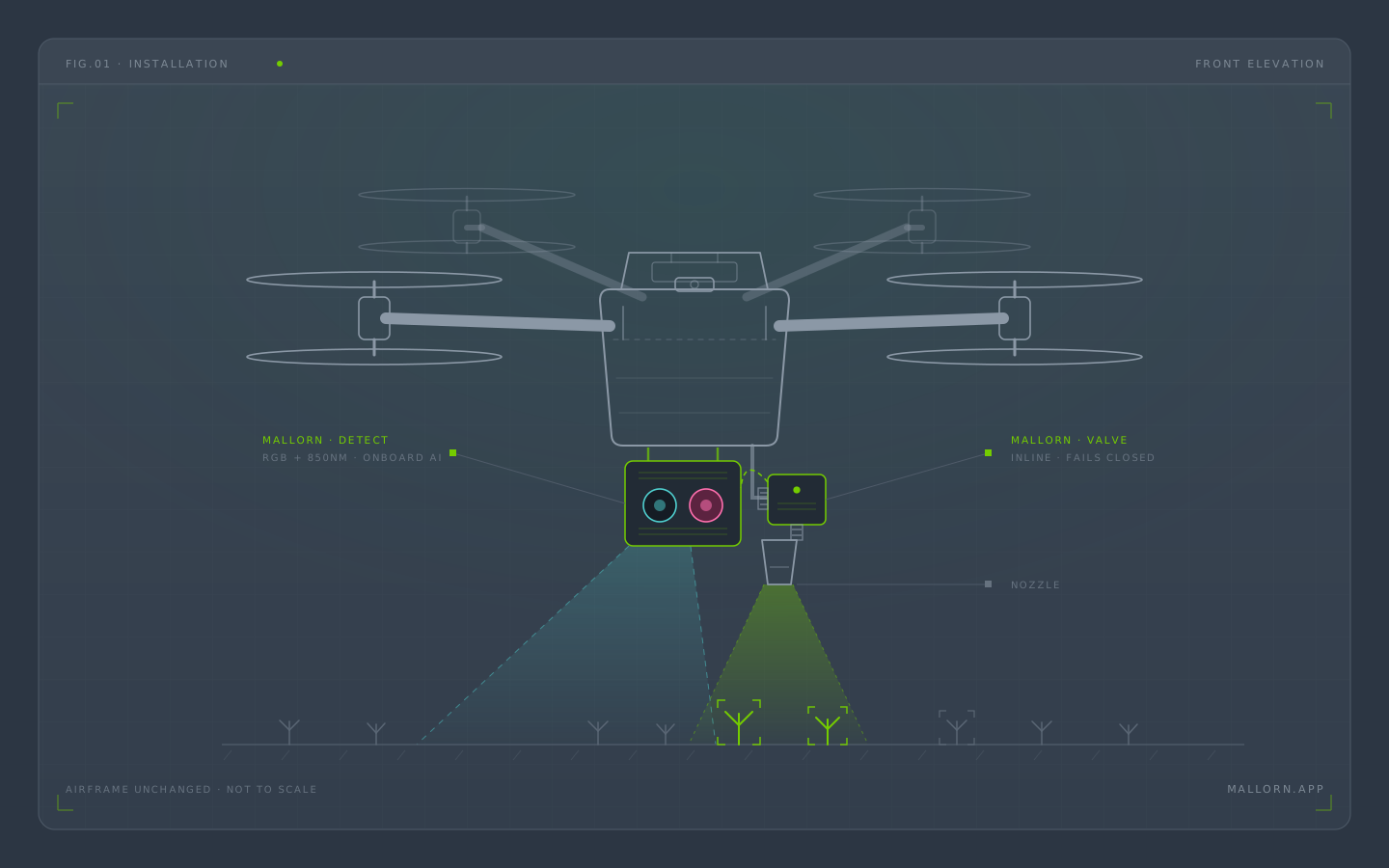
Front elevation of a multirotor spray drone. The Mallorn detect unit hangs under the body with its sensor cone covering the crop ahead, and the valve unit sits beside it on the line running down to the nozzle.

IllustrationNot to scale, and the aircraft drawn here is generic rather than any particular model. Bracket and fitting details vary by airframe.

MALLORN · DETECT· camera, AI, and control, sealed in one boxCAMERAVision AIon-device modeltreat / skip → probControlprob → valve dutyproportionalfail-closedMALLORN · VALVEVALVEinline · fails closedseedecidespraytwo sealed units, both bolt on · runs on the aircraft, no cloud, no computer to set up · your tank and nozzles stay yours
MALLORN · DETECT, sealed, bolts on
Camera
↓ see
Vision AItreat / skip → prob
↓ decide
Controlprob → valve duty · fail-closed
↓ spray
MALLORN · VALVE, inline on your line
Valveopens by duty · fails closed
two sealed units, both bolt on · no cloud, no computer to set up · your tank and nozzles stay yours
01

See

A camera and onboard model score every patch many times a second: does it need treating?

02

Decide

Confidence that a spot needs it drives the valve continuously, giving a measured dose rather than just on/off.

03

Spray

Treatment hits what needs it (weeds, hungry plants) and skips the rest.

FAQ

Questions, answered.

What is Mallorn?
Mallorn is an onboard AI that turns any spray drone into a targeted sprayer. It spots the weeds and nutrient-starved plants in real time and treats only those, skipping the healthy crop.
Which drones does it work with?
It's brand-agnostic. Mallorn is two sealed bolt-on units: a detect unit holding the camera, AI, and controller, and a valve unit that threads inline on the spray line it drives. Both mount on the drone you already have, and no proprietary ecosystem is required.
What does it detect and spray?
It detects weed clusters and nutrient-deficient plants (and flags drydown for monitoring), then sprays herbicide or foliar feed only where it's needed, instead of blanketing the whole field.
How accurate is the model?
89% detection accuracy on held-out validation imagery, trained on 56,000+ multispectral UAV images across three plant-health signals.
Does it need internet or a separate computer?
No. Everything runs on the aircraft, with no cloud and no computer to set up. The detect unit does all the thinking on its own hardware and drives the valve unit directly, so the two of them bolt on and run.
When can I get it?
Mallorn is in active development. Join the early-access list below to be first in line for the pilot, or reach out about investing.
Can I use it on something other than a drone?
Yes. Mallorn just needs a clear, top-down view of the crop from an appropriate height. It'll run on a ground-rig boom, a tractor mast, or any platform that gives it that overhead vantage. A drone is simply the most flexible way to carry it.
Can it retrofit my existing sprayer drone?
Yes, two ways in. Pair a generic drone with your own spray kit, or tap Mallorn into the pump line of an existing sprayer that lacks smart-spray. It's the same pair of units either way.
Do I need to change my tank, nozzles, or chemicals?
No. The valve unit threads into the line you already have, and all it decides is when and how far to open. You keep your own tank, nozzles, and chemistry, whether that's herbicide, foliar feed, or another input.
How does it decide how much to spray?
It's proportional, not just on/off. A control law maps the detection confidence to how far the valve opens, so heavily affected patches get a full dose and borderline ones get a measured amount.
What happens if the AI gets it wrong?
It's fail-closed by design. A safety layer checks the inputs, the tank budget, and the sensor feed every cycle and shuts the valve if anything looks off. The default is to not spray.
What crops does it work on?
Our proprietary AI was trained on tens of thousands of four-band (near-infrared + RGB) aerial images of corn and soybean fields across the US Midwest, covering thousands of distinct fields over several growing seasons, so it has seen a huge range of real-world conditions. Because it keys off visual signals like weed pressure and nutrient stress rather than the crop itself, it extends to other broad-acre crops, and accuracy on a new crop or region improves as we add imagery from it. See mallorn.app/crops/ for exactly what's trained today and what's next.
Who owns my field data?
You do. Mallorn runs on the aircraft and processes imagery in real time, and nothing is sent to the cloud, so the pictures of your fields and the spray maps they produce stay on your own equipment and under your control. The AI model that powers it is Mallorn's own intellectual property, developed and trained in-house.
Two ways in

Get in early.

Join the pilot, or back the build.

By joining you agree to our Privacy Policy and Terms. Expressing investor interest is not an offer or solicitation to buy or sell any security.